Archaeologists discover a child's skull built into the floor of a 2,500-year-old Scandinavian house
Archaeologists have unearthed evidence that men, women and children were subjected to violence within their communities in ancient Scandinavia — and that these victims were buried in unusual places, …
Archaeologists have unearthed evidence that men, women and children were subjected to violence within their communities in ancient Scandinavia — and that these victims were buried in unusual places, such as pits or wells or under a family's house or yard.
During the Scandinavian Iron Age and Viking Age (from roughly 500 B.C. to A.D. 1050), violent encounters between individuals and communities steadily increased, resulting in archaeological evidence of elite warrior burials and mass graves from battles.
To better understand the context of violence in the Iron and Viking ages, researchers analyzed 192 human bones from people buried in domestic areas at settlements in what are now Denmark, Norway and Sweden.
"The fact is that not all bodies ended up in monumental burial mounds in the Iron and Viking Ages, or even in more modest urnfields and cemeteries," the researchers wrote in a study published Sept. 28 in the Journal of Archaeological Method and Theory . Rather, some bodies — or pieces of bodies — were placed in postholes, pits, floors, wells, houses, yards and feasting halls.
The archaeologists discovered that at least 12 of the individuals had sustained a violent injury around the time of death. Half of those cases involved head trauma, while four people suffered multiple injuries. Most of the victims of violence were adult males, but there were two females and a child as well.
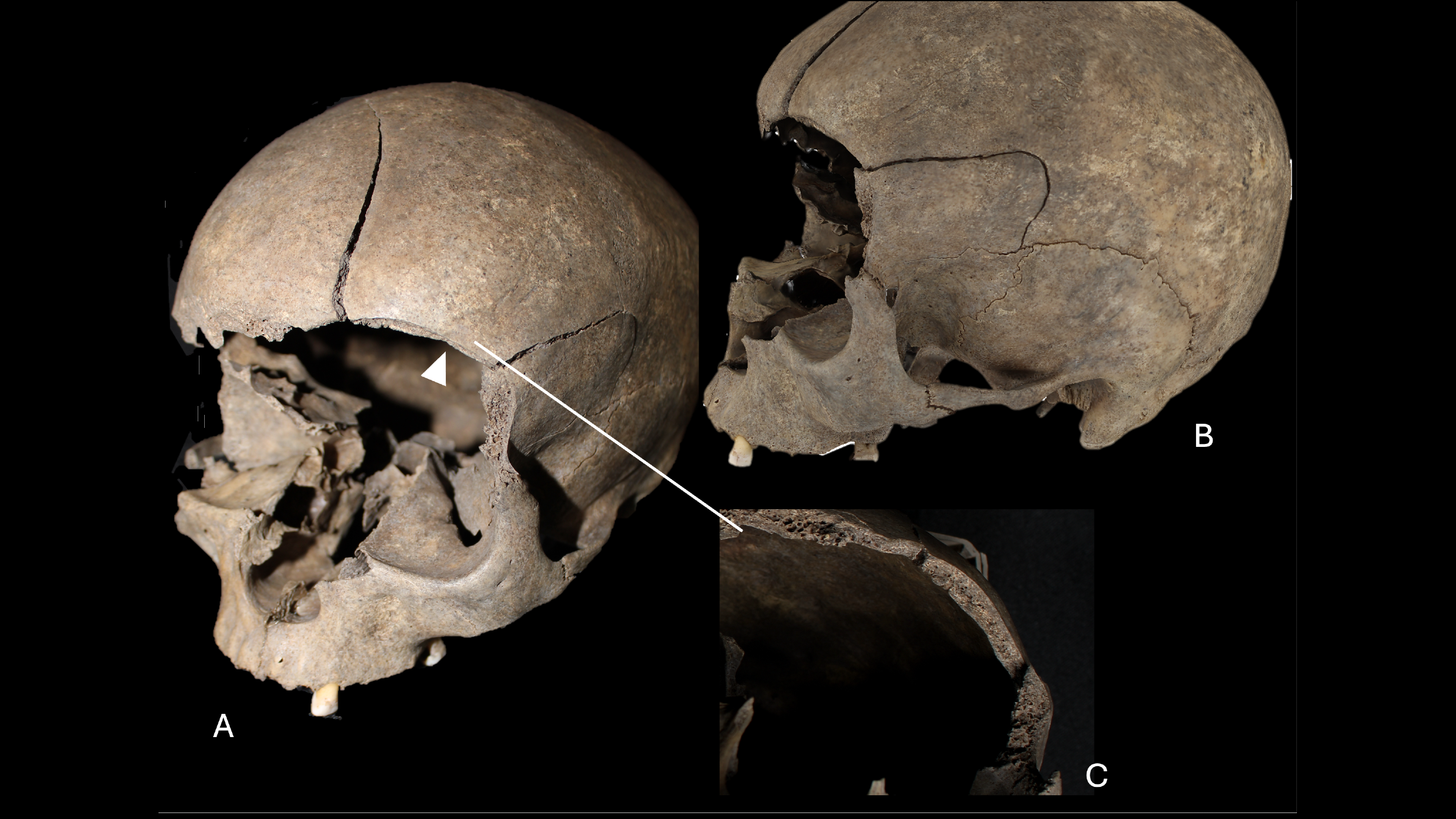
In one Iron Age house in Denmark, built sometime between 500 and 1 B.C., archaeologists discovered a frontal bone from the skull of a child who died between the ages of 2 and 4 years old.
"Our DNA analyses show that it is a small boy who has been cut with a sword," study first author Marianne Hem Eriksen , an archaeologist at the National Museum of Denmark, said in a translated statement . "The child's skull was placed on the floor of a house where people continued to live. This means that someone has walked over a child's skull day after day."
Get the world’s most fascinating discoveries delivered straight to your inbox.
Read Full Story at Live Science →