As crypto and prediction markets expand, their regulator shrinks
President Donald Trump shakes hands with Commodity Futures Trading Commission (CFTC) Chairman Michael Selig during a meeting with technology leaders in the Roosevelt Room of the White House, Wednesda…
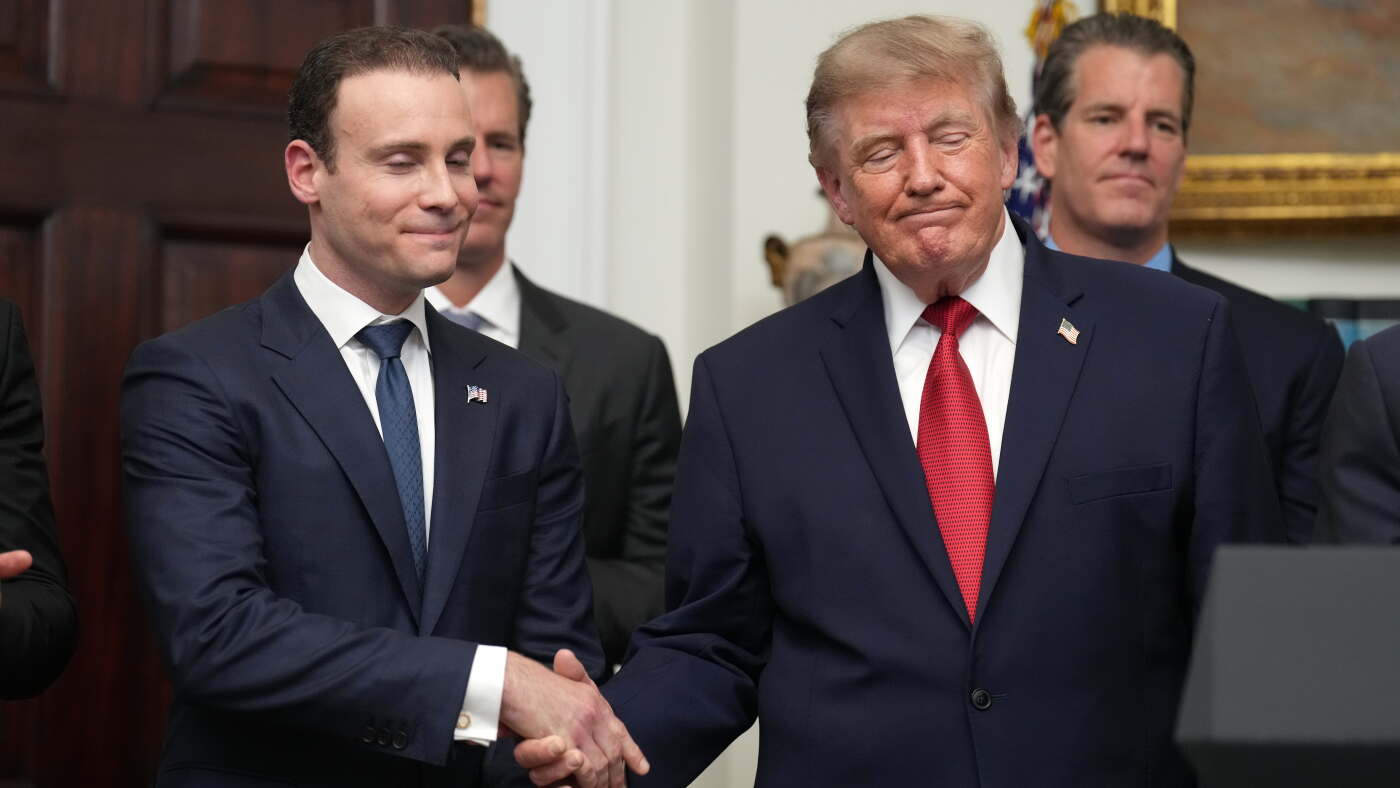
President Donald Trump shakes hands with Commodity Futures Trading Commission (CFTC) Chairman Michael Selig during a meeting with technology leaders in the Roosevelt Room of the White House, Wednesday, Aug. 19, 2026, in Washington. Jacquelyn Martin/Associated Press hide caption
Trump-era staff reductions have significantly hampered enforcement at the Commodity Futures Trading Commission and its ability to regulate burgeoning new prediction and cryptocurrency markets, where hundreds of billions are traded each week.
By the end of 2025, the CFTC had 21% fewer staff on its payroll when compared to the previous 10-year average, according to U.S. Office of Personnel Management data. Between January 2024 and January 2025 alone, staffing dropped 22%. And the number of CFTC enforcement actions dropped even further. The agency made nearly 80% fewer enforcement actions in 2025 when compared to the annual average for the previous decade, according to the agency's annual reports.
The CFTC started hemorrhaging staff soon after President Trump won the 2024 election. This was not a coincidence, according to Jeff Le Riche, who worked as a CFTC enforcement lawyer between 2005 and 2025.
"The Trump administration had run partially on a platform that it would be friendlier to the crypto industry," Le Riche said.
Leading up to the 2024 election, the CFTC under the Biden administration had leveled enforcement cases against cryptocurrency companies such as Gemini, Mirror Trading, Voyager, Celsius and FTX for fraud. It did the same against the crypto prediction market Polymarket .
After President Trump's inauguration, "in order to show results to that industry, some people were punished for bringing those cases," Le Riche continued. "The end result was that a lot of the people that worked on those cases either left or were forced out."
In a statement to NPR, the CFTC did not address that claim directly, but praised the work of current agency head Michael Selig.
Read Full Story at NPR Politics →