Cross purposes: how the England flag got caught in a tug-of-war between rightwing nationalists and football fans
Last summer the St George’s cross was co-opted by anti-immigrant groups. Now, as the World Cup begins, some communities are reclaiming it as a symbol of a very different sort of pride A s I drove into London with my daughter a week ago, we passed a roadside pub festooned with do
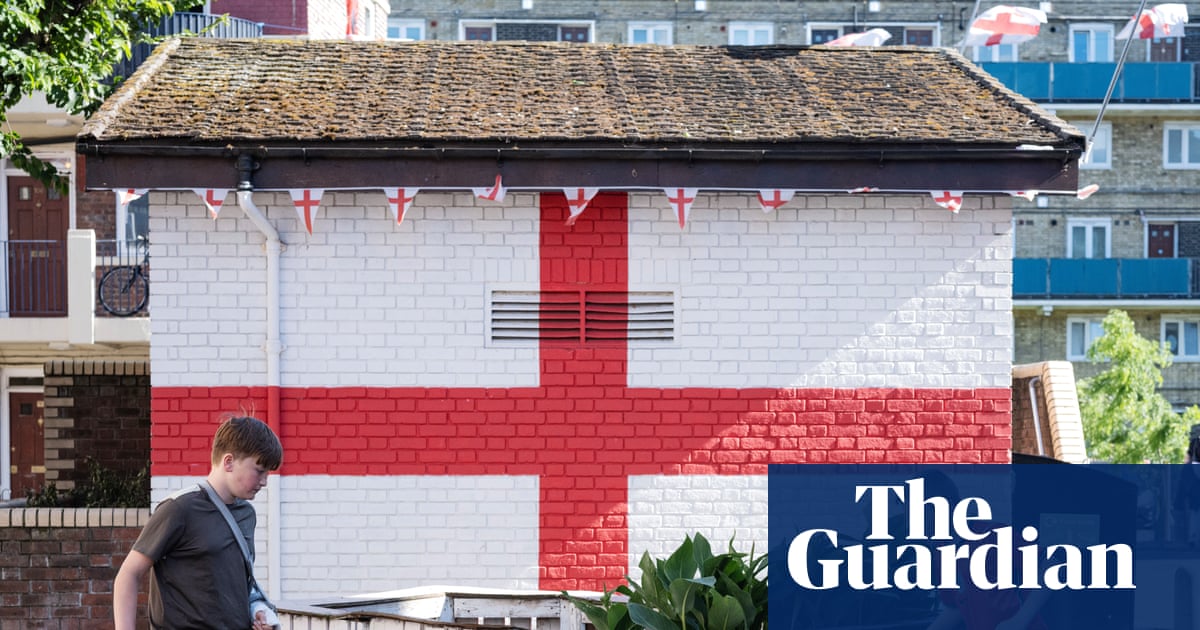
Last summer the St George’s cross was co-opted by anti-immigrant groups. Now, as the World Cup begins, some communities are reclaiming it as a symbol of a very different sort of pride
A s I drove into London with my daughter a week ago, we passed a roadside pub festooned with dozens of England flags. Our eyes met in recognition: we were in one of those areas, we assumed. In the eyes of many, St George’s cross flags have become a kind of territorial marker in the English landscape, signifying a certain kind of identity, a certain kind of politics, not necessarily welcoming to all. As we got closer, though, we realised the pub was actually preparing for the start of the World Cup . Flags of other nations were also on display. We laughed at our mistake and relaxed a bit.
It’s a feeling many Britons might have experienced. We’re gearing up for a summer of both exciting international football and ugly far-right protests and riots, as recent events in Belfast and Southampton have shown. The England flag will be a prominent fixture of both – great news for flag sellers, but a confusing and anxious time for the rest of us. How did England’s national symbol come to evoke such mixed feelings and carry such contradictory meanings? Are we really at the stage of “good flags” and “bad flags”? What are we supposed to think when we see an England flag?
Our politicians have been as uncertain about this as everyone else. That became clear last summer, when England flags and union jacks suddenly began to appear on lamp-posts in towns and cities across the country. St George’s crosses were painted on roads, roundabouts and elsewhere, sometimes accompanied by offensive graffiti . The initiative was pushed by groups such as Raise the Colours, a self-described “grassroots movement” that proclaimed it was campaigning “to cover Britain in symbols of unity and patriotism” – but it clearly generated local support too.
Some councils took steps to remove the flags – often citing “safety concerns” or rules against tampering with public property – but others leaped to their defence. Nigel Farage wrote a supportive opinion piece in the Sun: “We have had enough of our country and its history being trashed.” Conservative leader Kemi Badenoch said it was “shameful that some councils have scrambled to remove them at the first opportunity”. Reform MP Lee Anderson said that officials who supported removing the flags “should be removed from office for betraying the very country they serve”. Predictably, Stephen Yaxley-Lennon, AKA Tommy Robinson, supported the initiative: “The message to the councils actively seeking to take down England flags is … Operation raise the colours,” he posted on X last August. At about the same time, one “grassroots” activist putting up England flags in Lichfield, who claimed to have no political affiliations, admitted to a Sky News reporter that he’d been given the flags by Robinson himself the night before.
In early September Keir Starmer said: “I’m very encouraging of flags. I think they’re patriotic, and I think they’re a great symbol of our nation.” But he responded more robustly after the Unite the Kingdom rally a couple of weeks later, when more than 100,000 protesters gathered in London, many bearing and wearing British and English flags, to listen to far-right figures such as Robinson, France’s Éric Zemmour and Elon Musk (who told the crowd: “You either fight back or you die”). The next day Starmer stated: “Our flag represents our diverse country and we will never surrender it to those that use it as a symbol of violence, fear and division.”
The fear and division have not gone away, though. Nor have the flags. In the Southey Green area of Sheffield on Monday, every lamp-post along the main street still has both a St George’s cross and a union jack on it. One lamp-post at the top of the hill sports six flags: two St George’s crosses, a union jack, the Welsh and Scottish national flags, and a remembrance flag with poppies and planes. In March, an attempt by three young men to put up flags outside Chaucer secondary school, just around the corner, reportedly turned into an angry confrontation when teachers came out to object. “You see that? Unity. Save our children,” one of the young men shouted at them, pointing up at the flag.
Talking to people in the area – which swung from Labour to Reform in the recent local elections – most appear to be either in favour of the flags or indifferent to them. “There’s a lot of people who say: ‘Ooh, it’s racist.’ How is it racist?” asks Danny, a 37-year-old white man, from the porch of a house draped in several England flags. Alongside the weathered lamp-post flags, many homes in the area are displaying bright new England flags in support of the World Cup, Danny’s included. To him, he says, the flag simply means: “We’re proud of this country. And we want to be proud of his country again because in all fairness it’s gone to shit.”