Hubble captures M88’s fast dive through Virgo Cluster
Hubble’s image shows Messier 88’s bright core and star-forming regions, but its 250 km/s plunge through the Virgo Cluster is stripping its star-forming gas, likely turning it into a gas-poor “red and dead” galaxy. Studying this process helps scientists understand how galaxy clusters reshape galaxies over hundreds of millions of years.
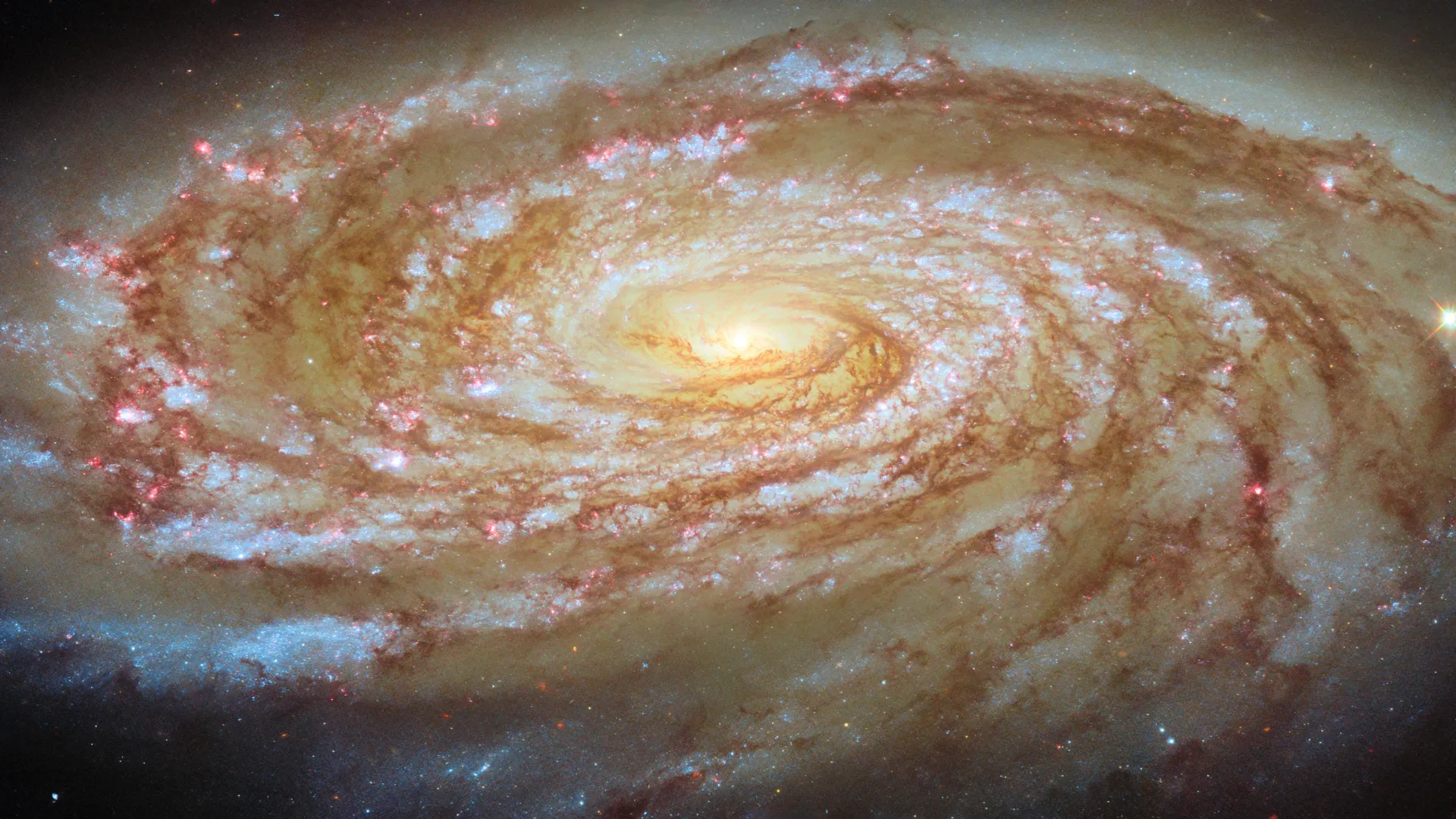
A stunning spiral galaxy called Messier 88 is racing through the Virgo Cluster at over 250 kilometers per second, a high-speed plunge that will dramatically reshape its fate. NASA’s Hubble Space Telescope has captured a sharp new image of M88, revealing a glowing heart powered by a supermassive black hole 100 million times heavier than our Sun, surrounded by bright young star clusters and swirling lanes of dust. But this cosmic beauty is on a collision course with the dense center of the Virgo Cluster, where intense gravitational forces and hot intergalactic gas will begin stripping M88 of the hydrogen gas it needs to form new stars.
The process, known as ram-pressure stripping, occurs when a galaxy moves through the intracluster medium—an extremely hot, diffuse plasma that fills galaxy clusters like Virgo. As M88 plows through this sea of plasma at high speed, the outer layers of its gas are pushed backward and torn away, leaving the galaxy increasingly gas-poor. Over the next several hundred million years, this relentless stripping could shut down star formation across much of the galaxy, transforming it from a vibrant spiral into a “red and dead” system dominated by aging stars.
What makes M88 especially interesting to astronomers is that it’s caught in a transitional phase. It still shows active star formation in its inner regions, but its outer spiral arms are already beginning to fade. This gives researchers a rare chance to study how environmental conditions inside a galaxy cluster can alter the life cycle of a galaxy. The Hubble image, with its crisp view of dust lanes and star clusters, offers a detailed snapshot of this transformation in action.
Understanding galaxies like M88 helps scientists piece together how the universe evolves on large scales. Galaxy clusters are crowded cosmic cities, and their harsh environments can determine whether galaxies thrive or fade. By watching M88’s perilous journey, astronomers hope to learn more about the fate of spiral galaxies entering dense clusters—and ultimately, how the universe’s structure changes over cosmic time.