📅 Tax Season 2026 58 days remaining  📁 Collect W-2s, 1099s & receipts first.
Free Online Tool

Word Counter & Text Analyzer

Count words, characters, sentences & paragraphs instantly. Advanced keyword density, reading time, and speaking time analytics — free, no signup required.

100% Free Forever Real-Time Results No Account Needed 500K+ Writers Use It File Upload Support

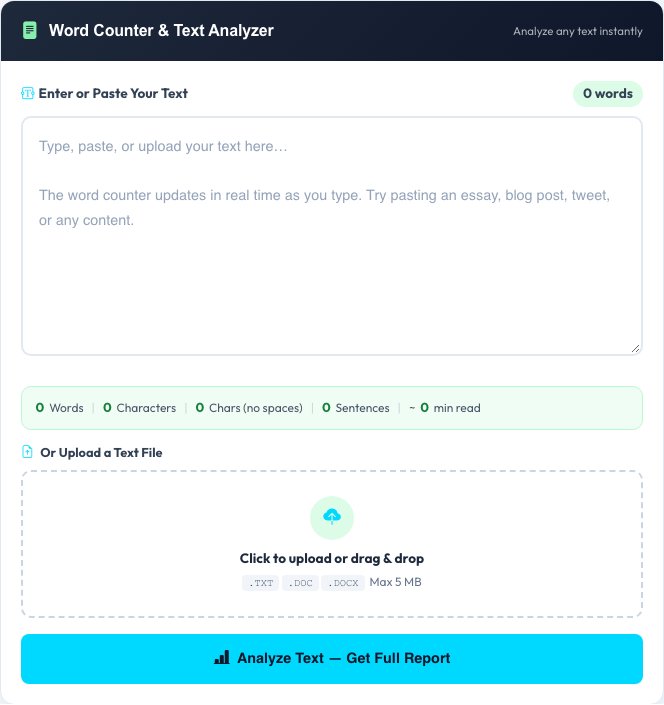
Word Counter & Text Analyzer

Analyze any text instantly
Enter or Paste Your Text 0 words
0 Words | 0 Characters | 0 Chars (no spaces) | 0 Sentences | ~0 min read

Or Upload a Text File

Click to upload or drag & drop
.TXT .DOC .DOCX  Max 5 MB

Enter text above or upload a file to see detailed analytics

Platform Word Limits

PlatformLimit
Twitter / X280 chars
Instagram Caption2,200 chars
Facebook Post63,206 chars
LinkedIn Post3,000 chars
Google Meta Desc160 chars
Google Title Tag60 chars
YouTube Title100 chars
YouTube Description5,000 chars
Reddit Post Title300 chars
SMS Message160 chars

Avg Word Length Guide

Children's Writing 3–4 chars
Everyday / Blog 4–5 chars
Business / News 5–6 chars
Academic / Legal 6+ chars

Content Length Standards

Tweet:  Up to 280 chars
LinkedIn Post:  500–700 words
Short Blog:  300–700 words
Standard Blog:  1,000–1,500 words
Long-Form / SEO:  2,000–3,000 words
White Paper:  3,000–5,000 words
Short Story:  1,000–7,500 words
Novella:  17,500–40,000 words
Novel:  80,000–100,000 words

Why Use Our Word Counter?

The most accurate, feature-rich, free word counter and text analyzer online — trusted by 500,000+ writers, students, and SEO professionals worldwide.

Real-Time Counting

Word and character counts update instantly as you type — no button click needed. See results change live with every keystroke.

Advanced Analytics

Go beyond basic counts. Get sentences, paragraphs, average word length, unique word ratio, reading time, and speaking time.

Keyword Density

Identify the top 10 most-used keywords with occurrence counts and percentage density. Essential for SEO content optimization.

File Upload Support

Upload .TXT, .DOC, and .DOCX files directly. The tool automatically extracts and analyzes all text content.

Reading & Speaking Time

Instantly know how long it takes to read or speak your content. Essential for speeches, presentations, blog posts, and videos.

Export to CSV

Download your complete text analysis report as a CSV file. Perfect for record-keeping, reporting, and sharing with teams.

Privacy First

Your text is only stored in history if you're logged in — and only visible to you. We never share or sell your data to third parties.

Works on All Devices

Fully responsive design works perfectly on desktop, tablet, and mobile. Count words anywhere, anytime, from any device.

How to Count Words Online

Our word counter is designed to be the simplest, fastest text analysis tool available. Follow these easy steps:

1

Enter or Paste Your Text

Click the text area and start typing, or paste your content using Ctrl+V (Cmd+V on Mac). The live counter updates immediately.

2

Watch Live Stats Update

See the word count, character count, sentence count, and reading time update in real time below the text area as you type.

3

Click "Analyze Text" for Full Report

Submit the form to receive a comprehensive analysis including keyword density, speaking time, unique word count, and more.

4

Export or Copy Your Results

Download your full analysis as a CSV file, or simply copy the metrics you need for your project, report, or documentation.

Who Uses Our Word Counter?

Our free word counter is used by millions of people across every industry and profession.

Students
Writers
SEO Experts
Bloggers
Speechwriters
Professionals
Translators
Journalists
YouTubers
Marketers
Developers
Everyone

Students & Academics

Meet essay word count requirements, check assignment lengths, and ensure academic papers are the right size. Works with college essays, research papers, dissertations, and theses.

SEO & Content Marketers

Optimize blog posts for search engines by checking word count, keyword density, and reading level. Google favors long-form content of 1,500–2,500 words for most topics.

Speakers & Presenters

Use the speaking time estimate to prepare speeches and presentations. Know exactly how long your script will take to deliver at a natural speaking pace of 130 words per minute.

AZRS Word Counter vs Competitors

See why writers and professionals choose our tool over other word counters.

Feature AZRS Word Counter WordCounter.net Google Docs MS Word
Real-Time Word Count✓ Yes✓ Yes✓ Yes✓ Yes
Character Count (No Spaces)✓ Yes✓ Yes✗ No✓ Yes
Keyword Density Analysis✓ Yes✓ Yes✗ No✗ No
Reading Time Estimate✓ Yes✓ Yes✗ No✗ No
Speaking Time Estimate✓ Yes✗ No✗ No✗ No
Unique Word Count✓ Yes✗ No✗ No✗ No
File Upload (.TXT/.DOCX)✓ Yes✗ No✓ Yes✓ Yes
Export to CSV✓ Yes✗ No✗ No✗ No
No Signup Required✓ Yes✓ Yes✗ No✗ No
Analysis History✓ Yes (if logged in)✗ No✓ Yes✓ Yes
Platform Word Limit Guide✓ Yes✗ No✗ No✗ No
100% Free✓ Always Free✓ Yes✗ Freemium✗ Paid

What is Word Count and Why Does It Matter?

Word count is the total number of words in a piece of text. It is one of the most fundamental metrics in writing, education, publishing, and digital marketing. Understanding word count helps writers meet requirements, manage reader expectations, and optimize content for search engines.

In academic writing, word count requirements ensure fairness and test students' ability to communicate concisely. In publishing, word count determines whether a work qualifies as a short story, novella, or full novel. In SEO content marketing, longer content (2,000–3,000 words) typically ranks higher on Google for competitive keywords because it provides more comprehensive coverage of a topic.

Character count matters for social media posts, meta descriptions, email subject lines, and ad copy where strict character limits apply. Our tool tracks both total characters and characters excluding spaces — the latter is often what platforms actually measure.

Understanding Keyword Density for SEO

Keyword density is the percentage of times a target keyword appears in your content relative to the total word count. It is calculated as: (keyword count ÷ total words) × 100

The ideal keyword density for SEO in 2024 is between 1% and 3% for your primary keyword. Too low and Google may not understand what your page is about. Too high (above 5%) risks being penalized for "keyword stuffing" — a practice Google's algorithms are designed to detect and demote.

Pro Tip: Instead of obsessing over exact keyword density, focus on writing naturally and covering your topic comprehensively. Use synonyms, related terms (LSI keywords), and answer common questions about the topic. Google's natural language understanding goes far beyond simple keyword counting.

How Reading & Speaking Time Is Calculated

Our tool calculates reading time at 200 words per minute (WPM) — the average silent reading speed for an adult. This aligns with what major publishing platforms like Medium use for their "X min read" estimates.

Speaking time is calculated at 130 WPM — the average rate for natural conversational speech. Formal presentations are typically slightly faster at 120–150 WPM, while audiobooks average 150–160 WPM.

Use speaking time to prepare conference talks, video scripts, podcast episodes, TED-style presentations, and classroom lectures. A standard 15-minute TED talk requires approximately 1,950–2,250 words.

200
Words Per Minute
Average Read Speed
130
Words Per Minute
Average Speak Speed
5 min
Read time for
~1,000 words
8 min
Speak time for
~1,000 words

Ideal Content Length for SEO in 2024

Word count is a key on-page SEO factor. Here's a data-driven guide to optimal content lengths for different content types.

Blog Posts for SEO

Competitive SEO blog posts should be 1,500–3,000 words. Comprehensive, pillar-page content targeting high-volume keywords often exceeds 3,000 words and consistently outranks shorter content in Google's search results.

Product Descriptions

E-commerce product pages perform best at 300–500 words minimum. Short descriptions fail to rank; longer, benefit-focused descriptions with natural keyword use convert and rank better simultaneously.

Landing Pages

High-converting landing pages range from 500–1,000 words for lead capture pages, up to 2,000+ words for long-form sales pages. More content = more keyword opportunities = better rankings.

News Articles

Breaking news articles can be as short as 300 words, but feature articles and in-depth reporting typically run 800–1,200 words. Investigative journalism can exceed 3,000 words.

Email Newsletters

Marketing emails perform best at 50–200 words. Long newsletters (500+ words) work for engaged subscribers but reduce click-through rates. Subject lines should be under 60 characters.

Social Media Posts

LinkedIn posts get highest engagement at 1,300–2,000 characters. Facebook posts peak at 40–80 characters. X (Twitter) allows 280 characters. Instagram captions peak at 138–150 characters.

Frequently Asked Questions

Everything you need to know about our free word counter and text analyzer tool.

Is this word counter completely free?
Yes, 100% free with unlimited use. There are no hidden fees, no premium tiers, no signup requirements, and no usage limits. You can analyze as many texts as you like, as often as you like, forever.
What file types can I upload for word counting?
You can upload .TXT (plain text), .DOC (Microsoft Word 97-2003), and .DOCX (Microsoft Word 2007+) files. The maximum file size is 5 MB. The tool automatically extracts all text content from the file and runs a full analysis.
How accurate is the word count?
Our word counter is highly accurate for English and other space-delimited languages. Words are counted by splitting text on whitespace. Hyphenated words like "well-being" are counted as one word. Numbers, special characters, and contractions like "don't" are each counted as one word — matching Microsoft Word's counting methodology.
Does this work for languages other than English?
Yes, our tool works for all languages that use spaces between words. This includes Spanish, French, German, Italian, Portuguese, Russian, Arabic, and many more. Character counts work for all languages including Chinese, Japanese, and Korean (CJK scripts). Word counting in CJK languages may be less accurate since these languages don't always use spaces.
Is my text stored or shared?
Your privacy is our priority. If you are not logged in, your text is never stored. If you are logged in, the last 5 analyses are saved to your private history for convenience — only you can see this history. We never sell, share, or use your text content for advertising or training purposes.
What is the difference between character count with and without spaces?
Total character count includes every character in your text: letters, numbers, punctuation, spaces, tabs, and newlines. Character count without spaces excludes all whitespace (spaces, tabs, line breaks). Many platforms — including Twitter — count characters without spaces for billing and limit purposes.
What is a good keyword density for SEO?
The industry standard is 1–3% density for your primary keyword. Above 5% risks being penalized by Google for keyword stuffing. However, modern SEO best practices focus less on exact density and more on topical coverage, semantic relevance, and user intent. Write naturally and use related keywords, synonyms, and phrases rather than repeating one keyword excessively.
Can I use this word counter to check my essay or thesis?
Absolutely. Our word counter is ideal for students checking essays, research papers, dissertations, and theses. Simply paste your text or upload your document to get an immediate word count. You can also track keyword usage to ensure your academic writing doesn't over-rely on any single term.

Writing Tips to Improve Your Content

Use these professional writing and SEO tips alongside our word counter to create better content.

Aim for sentences under 25 words

Long sentences are harder to read. The Hemingway App recommends keeping most sentences under 14 words. Break complex sentences into two simpler ones to improve readability scores.

Keep paragraphs to 3–4 sentences max

Web readers scan, not read. Short paragraphs improve readability and reduce bounce rates. Use our paragraph counter to ensure your content is broken up enough for online reading.

Use the Flesch Reading Ease score as a guide

Average word length reflects reading complexity. Shorter words (avg 4–5 chars) are easier to read. Academic writing typically averages 6+ characters per word. Match your word complexity to your target audience.

Repeat keywords naturally, not forcefully

Use our keyword density tool to check that your primary keyword appears at 1–3% frequency. If it's appearing too much, use synonyms and related phrases. If too little, work it in naturally where contextually appropriate.

Match content length to search intent

Informational queries need depth (2,000+ words). Transactional queries (buy, download) need focus (500–800 words). Navigational queries just need clarity. Don't pad content for the sake of length — quality over quantity always wins.

Calculate speaking time for presentations

Use our speaking time calculator before any speech or presentation. A 5-minute talk needs ~650 words. A 15-minute TED talk needs ~2,000 words. A 30-minute keynote needs ~3,900 words. Always rehearse with a timer to adjust pace.

Explore our full suite of free online tools for writers, developers, students, and content creators.

Text Analytics Glossary

Understand every metric our word counter and text analyzer measures.

Word Count

The total number of words in your text, counted by splitting on whitespace. Hyphenated words like "well-being" count as one word. The most fundamental metric in writing — used in academic requirements, publishing, and SEO benchmarks.

Character Count

The total number of individual characters including letters, numbers, punctuation, spaces, and line breaks. Critical for social media posts, meta descriptions, SMS messages, and any platform with strict character limits.

Chars Without Spaces

Character count excluding all whitespace (spaces, tabs, line breaks). Many platforms count characters without spaces for limits. Twitter counts non-space characters toward its 280-character limit for some content types.

Sentence Count

The number of sentences in your text, detected by splitting on sentence-ending punctuation (., !, ?). Monitoring sentence count helps you maintain variety in sentence length and avoid monotonous or overly complex prose.

Paragraph Count

The number of distinct paragraphs, counted by double line breaks. Short paragraphs (3–4 sentences) improve readability and reduce bounce rates on web content. Search engines favor well-structured content with clear paragraph breaks.

Unique Words

The count of distinct, non-repeated words in your text (case-insensitive). A high unique word ratio indicates vocabulary richness and stylistic variety — both positive signals for academic graders and content quality algorithms.

Reading Time

Estimated time to silently read the content at 200 words per minute — the average adult reading speed. Used by Medium, Substack, and major publishers to set reader expectations. Ideal blog posts have a reading time of 7–10 minutes.

Speaking Time

Estimated time to read the text aloud at 130 words per minute — average conversational speech rate. Essential for preparing speeches, podcast scripts, video voiceovers, sales calls, and classroom instruction within time limits.

Keyword Density

The percentage of times a specific word appears relative to total word count. Calculated as (occurrences ÷ total words) × 100. The SEO sweet spot is 1–3% for your primary keyword. Above 5% risks being flagged as keyword stuffing.

Word Count Standards by Document Type

Use this reference guide to check whether your content meets professional standards for length.

Academic Writing

Short essay500–750 words
Standard essay1,000–1,500 words
Research paper3,000–5,000 words
Dissertation10,000–100,000 words

Creative Writing

Flash fictionunder 1,000 words
Short story1,000–7,500 words
Novella17,500–40,000 words
Novel80,000–100,000 words

SEO Content

Product page300–500 words
Blog post (short)700–1,000 words
Blog post (standard)1,500–2,500 words
Pillar / long-form3,000–6,000 words

Business Documents

Business email50–200 words
Executive summary250–500 words
Business report2,000–5,000 words
White paper5,000–10,000 words

Speeches & Scripts

3-min speech~390 words
5-min speech~650 words
15-min speech~1,950 words
30-min speech~3,900 words

Social Media

X (Twitter)280 chars max
LinkedIn post1,300–2,000 chars
Instagram caption138–150 chars ideal
Facebook post40–80 chars ideal
All Tools
Homework Planner
GPA Calc
Flashcards
Citations
Study Timer
Grade Calc
Unit Conv.
File Compress
File Convert
PDF Merger
Image→PDF
Text Extract
Video DL
PDF Splitter
File Encrypt
BG Remover
FG Remover
Color Changer
Img Resizer
QR Code
Percentage
Loan EMI
Mortgage
Tax Calc
Salary
Currency
BMI
Tip Calc
Compound Int.
Translator
Summarizer
Transcription
AI Chat
Project Maker
Paraphraser
Word Counter
Case Converter
Paraphraser
Summarizer
Text Extractor
Find & Replace
Diff Checker
Text to Speech
Lorem Ipsum
JSON Format
Base64
Regex Tester
Speed Test
My IP
Notes App
Stock Advisor
Risk Simulator
CSV↔JSON
XML↔JSON
Base64
URL Encode
Binary↔Text
MoleMath
ChemScope
Periodic Table
SEO Analyzer
Speed Test
Keywords
Internal Links
Cannibalization
Tech Stack
Islam Home
Prayer Times
Quran Reader
Halal/Haram
Christianity
All Religions
Prayer Times
Athan
Qibla
Tasbih
Halal Scanner
Zakat Calc
Masjid Finder
Ramadan
Quran Reader
Hadith
Flappy Bird
Snake
Chess
2048
Tetris
All Games →
All News
Tech News
AI News
World News
Islamic News
Finance News
Sports
Science
Health
Web Dev
Tax Services
Business
Book Appt
Expenses
All Services