📅 Tax Season 2026 58 days remaining  📁 Collect W-2s, 1099s & receipts first.
المِيرَاث

Islamic Inheritance Calculator (Mirath / Faraid) 2026

Distribute an estate according to Quranic fixed shares (Fard) and residuary shares (Asabah) for all legal heirs.

"Allah instructs you concerning your children: for the male, what is equal to the share of two females..." — Quran 4:11
Surah An-Nisa 4:11–12 (Faraid verses)
📖 Quranic Fixed Shares 👨‍👩‍👧‍👦 All Heir Types 📊 Visual Distribution 📋 Print-Ready Report
🏛️
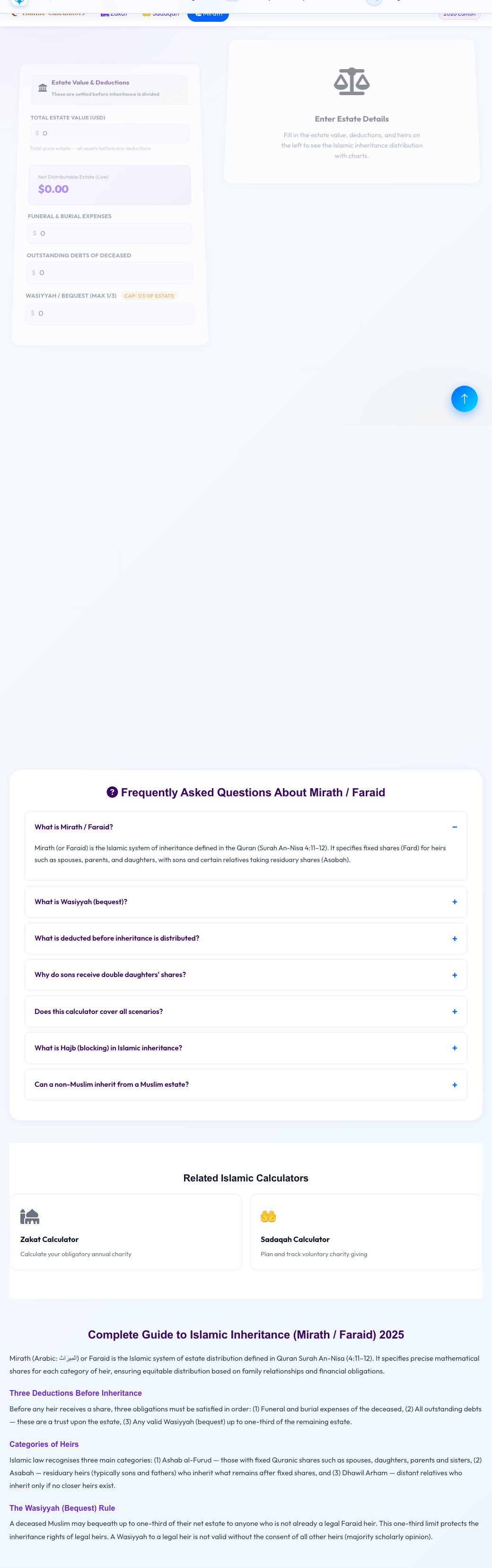
Estate Value & Deductions
These are settled before inheritance is divided
$

Total gross estate — all assets before any deductions

Net Distributable Estate (Live)
$0.00
$
$
$
⚠️ Wasiyyah exceeds 1/3 of the estate — it will be automatically capped at the legal maximum.
👥
Heirs
Select all surviving heirs of the deceased
0
0
0
0
0
⚖️
Enter Estate Details
Fill in the estate value, deductions, and heirs on the left to see the Islamic inheritance distribution with charts.

❓ Frequently Asked Questions About Mirath / Faraid

What is Mirath / Faraid?

Mirath (or Faraid) is the Islamic system of inheritance defined in the Quran (Surah An-Nisa 4:11–12). It specifies fixed shares (Fard) for heirs such as spouses, parents, and daughters, with sons and certain relatives taking residuary shares (Asabah).

What is Wasiyyah (bequest)?

A Wasiyyah is a will bequest. In Islamic law it is capped at one-third (1/3) of the net estate. It cannot be made to a legal heir (who already inherits by Faraid), though scholars of some schools differ.

What is deducted before inheritance is distributed?

Three things must be settled before heirs receive their shares: (1) Funeral and burial expenses, (2) All outstanding debts of the deceased, (3) Any valid Wasiyyah up to 1/3 of the remainder.

Why do sons receive double daughters' shares?

Under Islamic law, sons are financially responsible for their wives, children, and sometimes relatives. The double share reflects this obligatory financial duty. Daughters face no such mandatory financial burden.

Does this calculator cover all scenarios?

This tool covers the most common inheritance scenarios. Complex cases involving Hajb (blocking), paternal half-siblings, or Dhawil Arham (distant relatives) should be referred to a qualified Islamic scholar.

What is Hajb (blocking) in Islamic inheritance?

Hajb refers to the exclusion of one heir due to the presence of another closer heir. For example, the paternal grandfather is blocked (Hajb) by the father. Full brothers are blocked by sons or the father. This calculator handles the most common Hajb scenarios automatically.

Can a non-Muslim inherit from a Muslim estate?

According to the majority scholarly opinion, a non-Muslim cannot inherit from a Muslim through Faraid. However, they may receive a gift or a Wasiyyah (bequest) of up to one-third of the estate. Consult a qualified scholar for your specific situation.

Related Islamic Calculators

Complete Guide to Islamic Inheritance (Mirath / Faraid) 2025

Mirath (Arabic: المِيرَاث) or Faraid is the Islamic system of estate distribution defined in Quran Surah An-Nisa (4:11–12). It specifies precise mathematical shares for each category of heir, ensuring equitable distribution based on family relationships and financial obligations.

Three Deductions Before Inheritance

Before any heir receives a share, three obligations must be satisfied in order: (1) Funeral and burial expenses of the deceased, (2) All outstanding debts — these are a trust upon the estate, (3) Any valid Wasiyyah (bequest) up to one-third of the remaining estate.

Categories of Heirs

Islamic law recognises three main categories: (1) Ashab al-Furud — those with fixed Quranic shares such as spouses, daughters, parents and sisters, (2) Asabah — residuary heirs (typically sons and fathers) who inherit what remains after fixed shares, and (3) Dhawil Arham — distant relatives who inherit only if no closer heirs exist.

The Wasiyyah (Bequest) Rule

A deceased Muslim may bequeath up to one-third of their net estate to anyone who is not already a legal Faraid heir. This one-third limit protects the inheritance rights of legal heirs. A Wasiyyah to a legal heir is not valid without the consent of all other heirs (majority scholarly opinion).
All Tools
Homework Planner
GPA Calc
Flashcards
Citations
Study Timer
Grade Calc
Unit Conv.
File Compress
File Convert
PDF Merger
Image→PDF
Text Extract
Video DL
PDF Splitter
File Encrypt
BG Remover
FG Remover
Color Changer
Img Resizer
QR Code
Percentage
Loan EMI
Mortgage
Tax Calc
Salary
Currency
BMI
Tip Calc
Compound Int.
Translator
Summarizer
Transcription
AI Chat
Project Maker
Paraphraser
Word Counter
Case Converter
Paraphraser
Summarizer
Text Extractor
Find & Replace
Diff Checker
Text to Speech
Lorem Ipsum
JSON Format
Base64
Regex Tester
Speed Test
My IP
Notes App
Stock Advisor
Risk Simulator
CSV↔JSON
XML↔JSON
Base64
URL Encode
Binary↔Text
MoleMath
ChemScope
Periodic Table
SEO Analyzer
Speed Test
Keywords
Internal Links
Cannibalization
Tech Stack
Islam Home
Prayer Times
Quran Reader
Halal/Haram
Christianity
All Religions
Prayer Times
Athan
Qibla
Tasbih
Halal Scanner
Zakat Calc
Masjid Finder
Ramadan
Quran Reader
Hadith
Flappy Bird
Snake
Chess
2048
Tetris
All Games →
All News
Tech News
AI News
World News
Islamic News
Finance News
Sports
Science
Health
Web Dev
Tax Services
Business
Book Appt
Expenses
All Services